Arbor Heights Has A 'Downtown.' It's One Pottery Studio.
August 27, 2026
August 27, 2026
Ask someone who has lived in Arbor Heights for twenty years where the neighborhood's downtown is, and they will pause, then point you toward a plain building on SW 100th Street. Not because it has a stoplight, or a strip of shops attached to it. Because for years, that single address has been the closest thing this stretch of West Seattle has had to a commercial center. And by most accounts, it still is.
That is not an exaggeration for effect. According to the Wikipedia entry for the neighborhood, Arbor Heights is almost entirely zoned as residential property, with the nearest commercially zoned land sitting north in Roxhill or down the hill in Fauntleroy. There is no grocery store, no coffee shop row, no cluster of storefronts anyone would call a Main Street. What Arbor Heights has instead is a short list of specific, slightly hidden places that residents have quietly agreed to organize their lives around. None of them look like a downtown. One of them, oddly enough, gets called one anyway.
For 25 years, the building at 4208 SW 100th Street was Brace Point Pottery, run by artist Loren Lukens. In September 2021, when Lukens announced he was moving to central California to be near family, West Seattle Blog covered the handoff and referred to the site as sitting in what was once "downtown Arbor Heights," a phrase the outlet used as shorthand, the way you'd use a name everyone already understood.
The person who took over the space was Deb Schwartzkopf, who had spent eight years running Rat City Studios in nearby White Center and had outgrown it. She opened Rain City Clay in the building the following spring, keeping the address in continuous use as an art space rather than letting it turn over to something else entirely. West Seattle Blog quoted her saying:
"We couldn't be more excited for the opportunity to build on the legacy of this artist community."
The renovation, later documented by Ceramics Monthly, turned the building into a working studio with a wheel-throwing classroom for up to sixteen students, additional studio space in the basement, a kiln yard, and a gallery. Rain City Clay now runs alongside Rat City Studios as sister operations. The building's ties to the wider arts scene go back to Lukens' run there too, when he kept the gallery open for West Seattle's monthly Art Walk, a neighborhood-wide tradition that still happens on the second Thursday of every month across the peninsula's studios and shops.
What makes this worth noticing isn't the pottery itself. It's that the building's role in the neighborhood never depended on foot traffic, parking, or retail economics. It kept functioning as a gathering point because someone was willing to keep it running the same way, for the same reasons, when the previous owner stepped away. That is a different kind of continuity than a business district provides. A strip mall survives on volume. This building survived on succession.
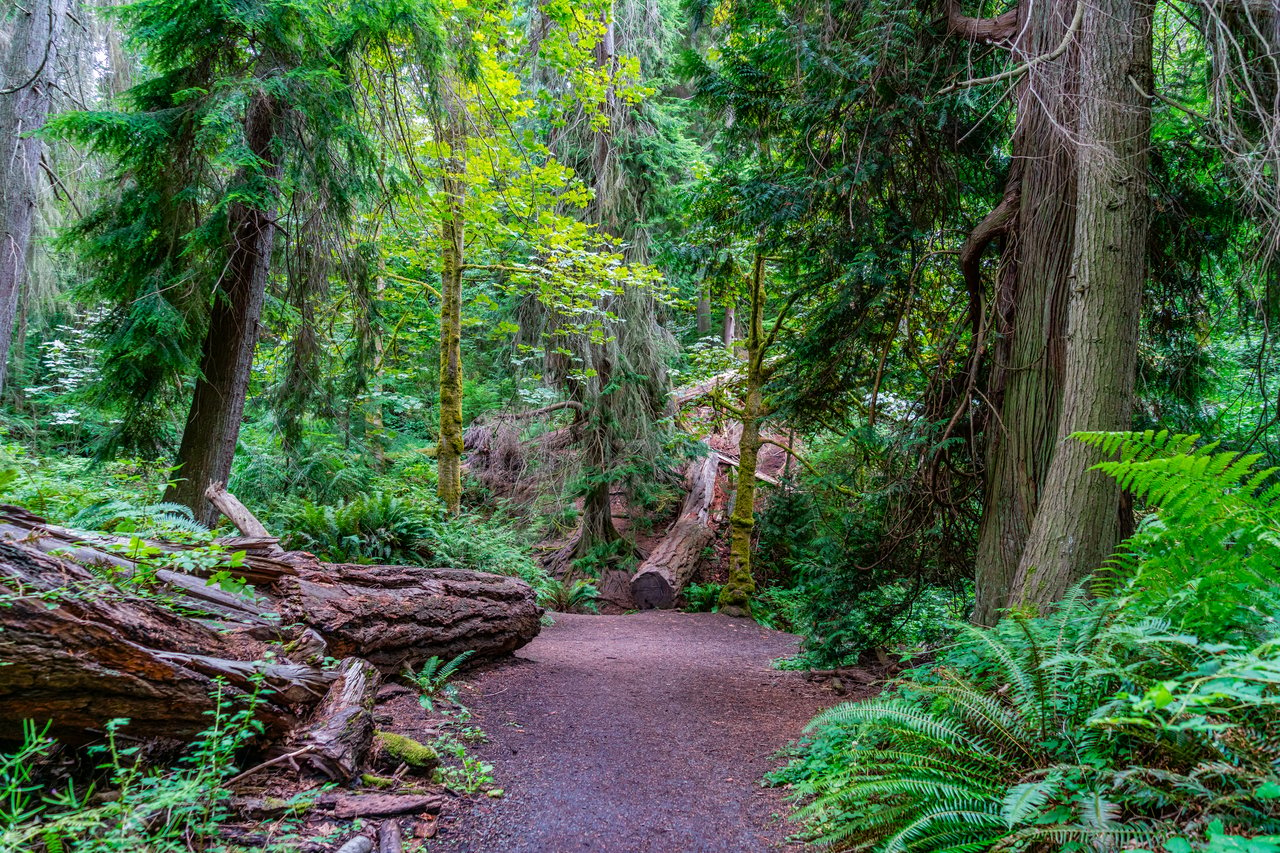
If Arbor Heights has a natural landmark to match its unofficial downtown, it is Seola Park, and it is just as understated. There is no formal trailhead sign pointing you toward it from 35th Avenue SW, where the road bends into Marine View Drive. A single-track trail drops down through the ravine and eventually connects to Seola Beach Drive, and along the way it passes through one of the last significant stands of native Pacific madrona left inside Seattle city limits, a detail a 2004 Seattle Times feature on the tree noted while describing the grove's rarity in a region otherwise dominated by conifers.
Seattle Parks' own description of the site is almost apologetic in its restraint, noting simply that there is a nice view of the water, but no beach access despite what a map might suggest. There are no restrooms, no paved lot, no interpretive signage explaining what you are looking at. What there is, is a grove that has survived disease, drought stress, and decades of development pressure on Puget Sound bluffs, the same kind of pressure that has claimed similar groves elsewhere in the city.
Residents who know about it treat it the way you'd treat a well-kept secret rather than a park amenity. That distinction says something about how this neighborhood relates to its own geography. Arbor Heights doesn't seem to need its best natural feature to be easy to find. It just needs it to still be there.
There is no public recreation center inside Arbor Heights. What fills that role instead is a private facility, the Arbor Heights Swim and Tennis Club, a membership pool that has functioned for years as the place where neighborhood families actually run into each other. In a city where most residential pockets rely on a Parks Department building or a school gym for that kind of casual overlap, Arbor Heights outsourced the job to a club that isn't run by the city at all.
That is worth sitting with for a second. A neighborhood without a downtown also doesn't have the civic infrastructure that usually anchors community life in denser Seattle neighborhoods. Arbor Heights filled that gap privately, the same way it filled its art-space gap with a pottery studio that changed hands rather than a business incubator or storefront lease.
Because there is nowhere to eat inside Arbor Heights, residents have effectively adopted the restaurants at its edges as their own. That list is short but specific:
None of these places belong to Arbor Heights on a map. All of them function, in practice, as its dining room and its errand run. That is a small but telling adaptation for a neighborhood that never had its own commercial core to begin with.
Put these pieces together and a pattern shows up that a generic neighborhood overview would miss entirely. Arbor Heights isn't a place waiting for development to catch up to its residential population. It's a place that solved the problem of a missing commercial center by making a handful of specific, sometimes accidental spaces do that work instead. A pottery studio that changed owners but never changed purpose. A grove that survives partly because it isn't easy to find. A private pool standing in for a rec center. A neighboring commercial strip standing in for a Main Street.
None of that shows up in a business census or a zoning map. If you actually live here, though, it's probably the reason the neighborhood feels the way it does, quieter and more settled than its West Seattle neighbors, without feeling underserved. Nothing here had to compete for space with anything else, so the things that lasted, lasted because people kept choosing them.
If you're in Arbor Heights and you've been wondering what that kind of staying power actually does to your home's value, or you're weighing whether now is the moment to make a move, Monroe Kemper knows these blocks the way a resident does, not just the way an agent does. Book a consultation when you're ready to talk it through.
Stay up to date on the latest real estate trends.